I started this day by scrolling through a very long and sometimes heated debate on Facebook considering the symbolism of different garments and accessories within my chosen game, the SCA. In this case (and it is in no way a unique discussion) it started with someone asking whether a cape could be worn without risk of social stigma. This might sound like a strange question at first glance, but considering it had gotten 140 comments within a few hours the subject is a complex one. Because everything we choose to wear can and most probably will be interpreted as a message to the world. The SCA, with rules and regulations written about some attire and very strong sentiments and traditions concerning others is not an isolated phenomenon in this matter.
It is known from modern day society that the way you wear your jeans sends out signals. And the way you wear your hair. And take care using earrings if you are male, or putting a handkerchief in your back pocket. And ladies are told not to wear to short skirts (hey, what happened to modern society?)
From history it is known or at least assumed that by using/wearing a garment initially worn by the opposite sex is sending signals of frivolity. Like young women wearing men's hats in 15th century german society (see some of my thoughts on that here: http://www.renikasanachronisticadventures.blogspot.se/2012/08/is-that-tarantula-on-your-head-or-just.html)
Another historical example is the Elisabethan masks that initially was worn by high society ladies, protecting their complexion from the sun when traveling, then used as a fashionable detail and cover when visiting the theatre (not a good thing for a woman of rank) and finally turning into something completely different: "They soon, however, became the mark of loose women, and their use was discontinued by women of repute."
http://www.pasthorizonspr.com/index.php/archives/12/2010/rare-mask-found-concealed-in-wall
Just imagine the social stigma of being a lady of repute, trying her best to be fashionable when visiting the city and going to the theatre, just to find out that wearing a mask is now something completely different from when cousin Anne did it four years ago...
So, how to deal with all this symbolism and not risk being mistaken for something that you are not? Well, if I wasn´t sure it would tick some off, I would say "go butt naked". And since that easily is ruled out, I guess we all have to do our very best in avoiding something clearly symbolical, like circlets of Laurel wreaths or Pelicans, crowns and coronets, plain colored belts and such. And help each other to enjoy the game by not acting harsh and assuming that people make mistakes on purpose. Courtesy is always the best approach. And these discussions is probably not the best thing to show newbies trying to figure out how to make their very first garb.
onsdag 5 juni 2013

måndag 20 maj 2013
No panties
The debate for whether ladies had panties or not is now in for a new chapter, thanks to the Lengberg finds. The finds include a pair of tongs, that looks a lot like a modern day bikini underpart, and I have seen several pictures of ladies wearing a reproduction of these together with the Lengberg brassiere. Well informed of this debate, Beatrix Nutz, who is now analyzing the finds, aims to have them, both knickers and brassieres, DNA-tested so that the sex of the wearer may be determined. Fingers crossed.


For me, these two pictures kind of sums it up for me:

Albrecht Dürer in a selfportrait wearing a tong.

The underpants from Lengberg.
The rest goes without saying. And this does not state by any means that women did not wear something at those days of the month when it was needed, but those will most likely newer be found since they ought to have been disposed of more secretly.
måndag 13 maj 2013
A kirtle´s diary
Since I couldn´t go to a whole week event with just one dress in thick brown wool, what if the weather turned out nicer than promised, I had to sew myself at least one new kirtle. Said and done, I had gathered some images and studied the sleeve-cut that I wanted to try out and thought I would challenge myself a bit again. And why stop there? No, I picked the fabric I got at a flea-market for handicrafts, one piece 1,5x0,5 metres and one piece of 1,5x2 metres. No chance of getting more anywhere should I cut it wrong. It is a really nice reddish brown thin wool in a twill weave.
 It took some thinking, but I managed to get the bodice and sleeves fitted into the smaller piece which left the larger portion of fabric for the skirt-parts of the kirtle.


 Ironing the bodice back before assembling the bodice and then the easy part, stitching the four skirt-panels together and finally assembling it all. I use a hot iron and a damp cloth to protect the fabric when ironing it.
 I did consider sewing a strip of fabric covering the seam-allowance between the skirt and the bodice to avoid shafing, but decided not to. The fabrics are pretty smooth anyway.
 Finally, time for eyelets, having felled all seam-allowances and hemmed the entire dress. This should be done in no-time, right?


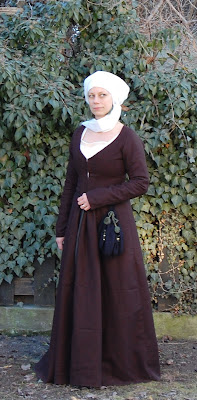
The dress got done in time, eyelets and all, and I enjoyed wearing it with my new striped veil that got hemmed while traveling for the event. This is me outside Hovdala castle all dressed up, and the other picture is when wearing the striped veil, which came in very handy when touring the insides of the castle with really low doorposts and sloping floors. The guide spoke of a gardener that once got a concussion trying to get through one of the doors, misjudging the height entirely.
But of course there is always room for improvement. I find the sleeves a bit hard to move in, so I will take them out and tweek it for a bit. Might even make a new and longer gusset in the back in order to get more room.
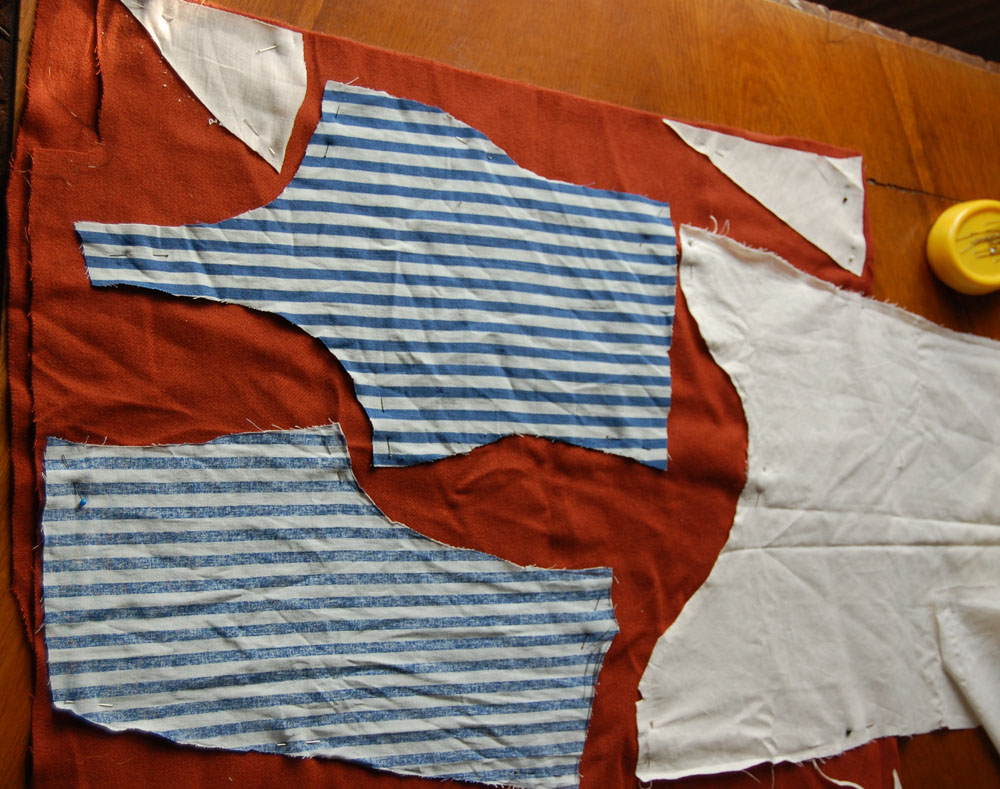

Then I had to try to decide on what to use for lining, the choices being a non-bleached linen or a really thin green wool. With some support I decided on the wool, mainly because it went so well with the brown colour-wise.

When the lining was cut I first basted along the seam-allowances to keep the to fabrics together before starting sewing the pieces together. Starting with the sleeves I stitched the sleeves and two gussets together, pressed the seams, cut down the seam-allowances and then started felling all seams.


The dress got done in time, eyelets and all, and I enjoyed wearing it with my new striped veil that got hemmed while traveling for the event. This is me outside Hovdala castle all dressed up, and the other picture is when wearing the striped veil, which came in very handy when touring the insides of the castle with really low doorposts and sloping floors. The guide spoke of a gardener that once got a concussion trying to get through one of the doors, misjudging the height entirely.
But of course there is always room for improvement. I find the sleeves a bit hard to move in, so I will take them out and tweek it for a bit. Might even make a new and longer gusset in the back in order to get more room.
Fake it til you make it
Since I got the kids my hair is just not as full any more and braiding it is not as fulfilling any more. But braids are not optional when reenacting German 15th century, they show under the headdress all the time. I was considering buying fake hair, but I don´t like modern fake materials (I can tell you stories of how much money that has saved me when stopping me from buying mixed material fabrics...). So just before leaving for Double Wars, a week-long event, the Curious Frau laid out pictures of fake hair made of strings or yarn, and even in fancy colours.
 On the altar you see St Klara´s fake hair in bright blue and her gefrens in yellow. This had to be tried, I thought, waking up at four in the morning of departure and remembering a set of bright blue silk/mohair-yarn in my yarn basket. It was found in time and at the event I tried it out. I divided it into three, made a small braid holding it all together in the middle. The braided part I put in the neck and then divided my hair and braided it together with the blue yarn. The yarn being longer than my own hair helped keeping my braids together and lengthening them so that it easily wrapped around the forehead. These pictures show it worn with a simple orange gefrens.


tisdag 23 april 2013
I´ve got stripes!

I fell in love with this beautiful but oh so simple striped veil the first time I saw it and have ever since been looking for a woven striped linen. And that is hard to find, I tell you! But this weekend me and the husband ran away on a little vacation of our own in London (yes, without kids!) for my birthday. The birthday was wonderfully spent with shopping in the textile district at Goldhawk Road. And there I found it, an orange striped rather thin linen. And dead cheap too. Now it will be carefully washed following Marias instructions (http://indemejarecristi.wordpress.com/2013/04/16/a-short-guide-washing-guide-for-linen-2/) and then hemmed. I think I just might make into one three metre long veil...or two 1,5 metre long ones. Either way it will give my rather slim closet some well needed variation.

torsdag 18 april 2013
Keeping track
How often have I not scolded myself for not saving my patterns? So this time, sewing a new short-sleeved dress with a new sleeveversion, I decided to for once be a good girl and drafted all the pieces on cotton fabric, marked every piece and put it in a marked envelope. I have done this with some items, but often forget.
 Some of my patterns have gotten used by many more than me, and the most popular one is the one I made for my knee hose. And it is so much easier to show someone how I made something when I have the pattern.

måndag 8 april 2013
All dressed up Housebook style
This started out as a keen interest in the late
15th century German garb a couple of years ago, and I have made some
tryouts aiming for a dress with the pleated panels in front and back as seen in
so many drawings and paintings from the time and region. However, I struggled
with how to get enough bust support with such a lowcut dress with the pleated
panels and never found a good way of doing it. Until the first pictures of the
Lengberg finds hit the internet, showing supportive underwear from just the
right time and place! Here was the answer to all my garbquestions. No need to
make the dress work supportive, it is all done by the under-garments. And since
I lost a lot of weight and changed size, the need for making new garb got
urgent and a friend then asked the trick question – When going new, will you
focus on just one time and region and explore it completely? I raised to the
challenge and this is the first results. The accessories are not all completely
new but made by me within the last three-four years.
 |
| My Lengberg brassiere all done |
In some details I have to refer to pure
guesswork, where no good sources of preserved garments and/or good detailed
artwork are to be found, but I then aim to do an educated guess, based on
sources from other geographic regions than my chosen one, either actual finds
or artwork.
The shift
My inspiration for the shift is a
variety of paintings, mainly by Albrecht Dürer, showing both men and women
wearing elaborate smocked and embroidered shirts/shifts, all showing in the
deep V-necked kirtles or jackets. When examining them closely, you´ll find that
it is most likely a very fine and tight smock with white-work embroidery
covering the pleats and then a small ribbon or golden lace attached to the
neckline. In most of Dürers female portraits the shift shows covering the
shoulders and neck as well, but in his selfportrait it is clearly a different
model, with a tight smocked frontpiece and the shoulders of the shirt not
showing at all. In other depicitons of women the dress is always a deep V-neck
but there the shift is only showing in the bottom of the V as a small insert. I
have therefore chosen to make a simple shift with some more work done on the
front panel, that will be the only thing showing. And after quite a lot of
experimenting I had to give up the idea of actual whitework over the pleats. In
some close-ups it looks like couched whitework and that is simply too much to
chew on for me right now. So my shift, in a rather sturdy hemp that holds the
pleats nicely, is inspired by Dürers shirt but not as elaborate. The embroidery
is a simple smock done in golden and white silk. The cut is a simple one, a
A-shaped backpiece, two frontside-panels, the inserted pleated frontpanel and
arms with a square gusset. This cut seems to be in style, as far as style goes
concerning undergarments, for centuries, shown in English 16th
century fashion and in the early
medieval days, shown in preserved garments like Thomas Becketts shirt or
Infantin Marias shift from the 12th and 13th centuries. The shape of undergarments of
course vary as they start to show, with wider arms if shown in slits or open
and laced arms, but when not showing and worn under a tighter straight sleeve
the arm of the undergarments is adjusted. I have therefore chosen a straight
arm in my shift, not to tight so that I can push them up when needed and so
that it is not too bulky under the straight arm of the dress.


The dress/kirtle
I have long wanted to make what is popularly named “the Housebook dress”, after the numerous pictures done by an anonymous engraver and painter, who lived and worked in South Germany in the last quarter of the 15th century.


The three pictures above shows some of the variety of dresses in his and others artwork,
but they all have the characteristics of a deep V-neckline showing the shift
and pleated panels in the front. In the St Catherine-picture you clearly see
the cut of the dress, with a waistseam, not showing in the pleated frontpanel,
which was propably one whole without the waistseam. Most of the width in the
skirt seems to come from the pleats and not from the sidepanels at all. In
Dürers portrait of the young girl the same inserted pleats show in the front
and the dress seems to be with a waistseam, however not that obvious. In this portrait it is also noticable that there must a front opening.
 |
| This is one of the two frontpanels, stitched for pleating, with the seams 1 cm apart. |
 |
| This is the turnout |
 |
| Measuring in order to know how large to make the cutout in the bodice. |
 |
| The frontpieces of the bodice with cutouts for the pleated panels. |
 |
| Front of the lining, showing the lining extended so that it completely covers and protects the pleats. |
 |
| Backpiece with lining, stitching all seams together before assembling the bodice. |
 |
| Stitching the backpieces together. |
 |
| The back with inserted pleated panel. |
 |
| I´m quite happy with the turn-out of the sleeves with the large armscye. I have used one big gusset in the sleeve. |
The headdress
The gefrens
is a little fringe of wool yarn fastened to a ribbon to tie around the head
under the veil. There are depictions of young women using only the gefrens over
their braided hair and there seems to be a variety of colours, even
multicoloured ones. Mine is simple green, and made by using the loose threads
as weft into a woven ribbon using a rigged heddle.
 |
| The lady on the left is wearing the full headdress with veil, vimple and gefrens, while the lady on the right just wears the gefrens over her braided hair. |
Belt, purse and stockings
Now for the
last finishings. No attire is complete without these things, a belt, a purse
and a pair of stockings.
The belt is
the simplest belt ever, since I haven´t found any pictures of elaborate women
belts in the artwork from this time and region, but simple, thin belts just
enough for holding a purse. Black leather in a 1 cm wide strip, with a very
simple brass buckle, sewn to the belt.
The purse
is another story, I found these purses with a number of smaller purses attached
to it, in drawings and etchings by Albrecht Dürer.


I made mine
in a good quality dark blue wool in a foursplit pattern, and four smaller purses
attached, one on each of the four pieces. I have used beads of bone and metal
for fastening the lucet cords use for the purse, all made in green wool yarn.
And around the opening I used a red lucet cord for reinforcment and adornement.
The
stockings or kneehose are in the area of the educated guess. I have not found
them in the artwork, nor in any preserved examples from this region. Kneehose
have however been found among the Herjolfsnes garments, made in wool and with
no whole foot, and
a hose fragment has been found in Lubeck as well as one possible kneehigh hose from London. All these preserved examples are in
wool, sewn and dated from late 13th century to 15th century. Sewn stockings are
therefore my choice for keeping my feet warm.
And this is how it all looks:

Prenumerera på:
Inlägg (Atom)