Visar inlägg med etikett hemd. Visa alla inlägg

söndag 11 juni 2017

I might need to make a new dress for this shift

As many may know, I am a huge fan of the art of Nüremberg artist Albrecht Dürer. One of my absolute favourite pieces is his portrait of the Young fürlegerin with her hair in braids. I have looked at this so many times and I still find new details in it. Now I want to look specifically on her shift, or hemd as it is called in German.
It is a lovely hemd, with an embroidered smocked front and black lining along the neckline. But as one looks at many different portraits and paintings from the same time and region, I noticed something about that neckline. The back seems to be drawn down towards the front so that the back neckline also covers the entire shoulder. I will try and illustrate what I mean with some more pictures.

Wolf Traut, Portrait of a woman, Nüremberg 1510

Hans Holbein the Younger, Portrait of a woman

Detail of a painting, showing the Young woman in green in a similar hemd
The back seems to be a rounded line, not indicating a seam or anything other than over the front shoulder where it meets the front.

I found this a bit intriguing so I had to experiment a bit with a simple version af a hemd, where the back is wider than the front, thus curving down over the shoulder and forming that seamless line down the front.

So my version is a plain shift in two pieces, two sidegores and sleeves and in order to clearly illustrate the slanted backpiece/shoulder, I put in a small lining of the neckline in black silk. Here it is:
The shoulder part hanging down in the front

The hemd when done


Construction with sidegore sewn directly to the sleeve

Worn with my blue Hausbook dress over it

And clearly I have nothing to wear on top of it, since all my dresses are fairly high in the neck and doesn´t show anything of the shoulders.


måndag 25 november 2013

Just added a little piece of bling

So it is done, my new smocked shift. This time I tried hard not to make a neckline that scoops too low, a thing I always manage to do with my shifts. It took a few times of pinning, trying it on, repin it and repeat.

The inspiration is mainly the finely smocked shifts and shirts from really late 15th C Germany, such as Dürers shirt, and I looked into the larger number of extant Italian camicias of the 16th C for the cut and also decorations. Here are one example of the sleeve and gusset that I liked:
I did however choose a different layout of the gusset since I did not want to much fabric to gather in the armpit of my rather slimfitted kirtlesleeves. Another great inspiration is the shift of Mary of Hungary, ca 1520:
When I displayed my last smocked shift (read about it here: http://www.renikasanachronisticadventures.blogspot.se/2013/04/all-dressed-up-housebook-style.html), I did get the question why I had made such big and coarse pleats in the neck insert. I thought about it and figured I was just taking the easy path and thus challenged myself a bit this time. So I made the pleats so tiny I had problems getting them to form, and got the tip on damping the fabric and then gently pull in the direction of the pleats, and the linen gently pleated itself.

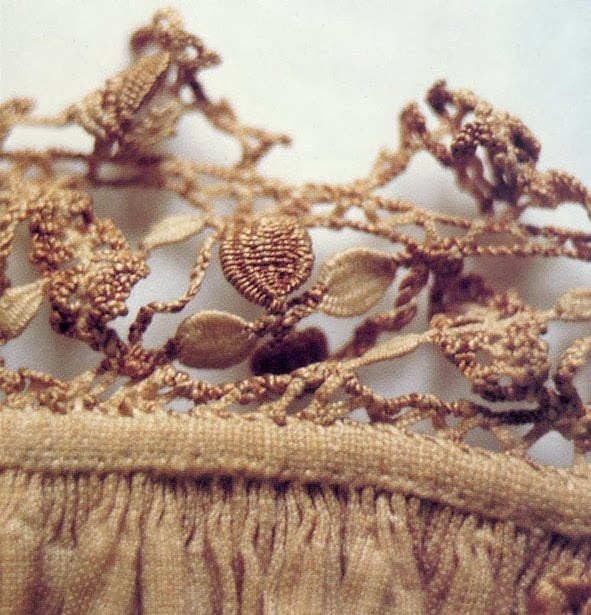
One of the main reasons for making this rather plain shift with a simple white smock was that I wanted to use the lovely antique golden lace I got from my mother in law, forming the edging of a lovely but really worn brocade table cloth. And there are some extant camicias with golden lace on the edge, excellent inspiration:

And this is how it turned out, with a side gore inserted and replacing the armpit square gore. The cuffs are plain and simple, since they will not be showing at all.
It took some effort to get the bias sewn to the smocking on the neckline and then attaching the lace, but I do think it was worth every minute and every pricked finger, this will for sure be a well used smock.
 First I pinned the bias strip over the smocking, trying not to stretch it too much.
 Then I sew the bias down over the edge, thus forming a firm edging for support of the rather heavy golden lace.
 The lace was pinned on and then sewn with a fine brown silk, that does not contrast too much to the rather old looking lace.

onsdag 2 maj 2012

Better late than never

I started on a new hemd in January. It didn´t get done in time for the Carnevale in February. Ah well, I thought and brought the pieces on my journey to Finland, thinking that hours and hours of dreary ferry-travel would do the trick. But alas, no.

Now it is finally done and I´m pretty pleased with myself.

It is sewn in a rather heavy nettle fabric, a bit golden white, and is mainly inspired by the german-swiss embroidered smocked hemds seen on both men and women in the late 15th and early 16th century.


Dürers portraits is the main inspiration for the undergarment


This is the result, however it will look a lot less bulky with the tight overdress
 I wanted to try the techniques with letters and fancy patterns in white on white but had to give it up. The fabric is too heavy and the pleats in the inserted front panel is just to coarse. So I settled on a more easier counted geometric pattern in golden silk and some rows of white stitches to keep it all together. The back and side panels are flat so that they do not take too much room under a tight fitted bodice. The front is made of a panel out of the full width of the fabric (150 cm) folded in the top and then pleated it in rather big pleats (1 cm). This will show in a rather deep V-neckline.


I haven´t given up on the idea of a more elaborate embroidered smock but then I need a finer linen and time and patience that I do not have at the moment. This is however a lot more elaborate than my first attempt as seen on my profile picture, so with time I will get there for sure.