söndag 30 mars 2014

Springcleaning the medieval wardrobe

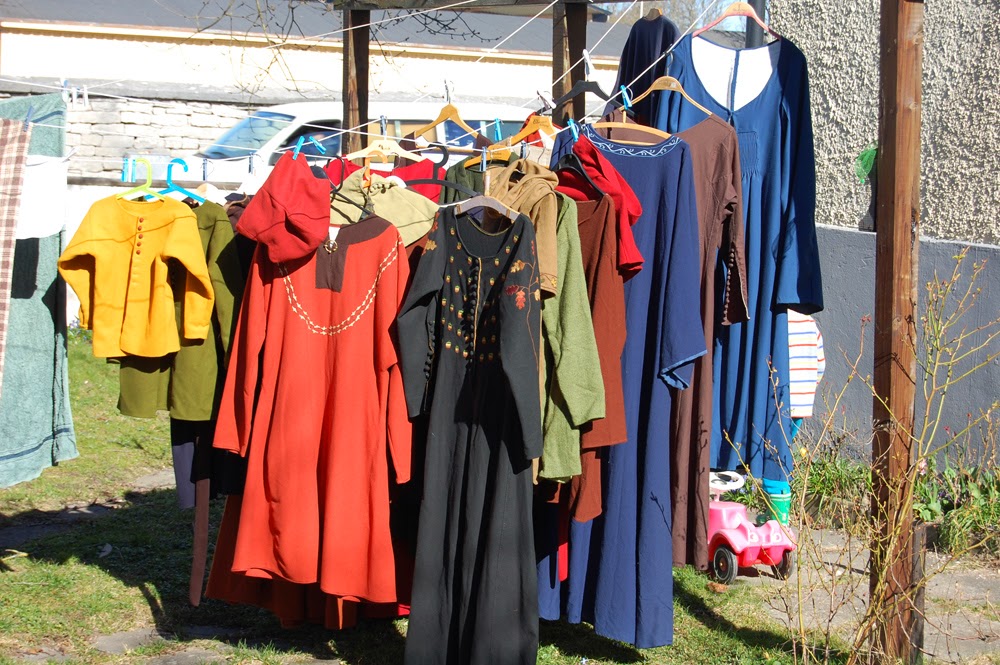
Yesterday we had the first warm day of spring, with sunshine and birdsong. Perfect for some spring cleaning and preparing your garb for a new event season. To take good care of all your wooly stuff, here is some tips and tricks for you.

Wool does not need to nor keep well if washed frequently. I hardly ever wash my wool clothing in the washing machine, since it is hard on the fibres and I want them to last long, considering the investment I made in money and work hours.

First of all, air your clothes at least once a year. Pull out everything and hang it freely so that the fresh air reaches into every crease and fold. This also prevents moth attacks. I let them hang for two-three hours.
Go over every garment and check for stains, holes, or ripped seams and fix them right away. Here is how I take out stains of food or drink on wool, with baby wipes or a moist cloth.
One thing that I almost always need to mend are my kneehose. They are patched several times and here is how I do that.
 When I made them, I did think first and made the choice of making the soles in a steadier and thicker wool than the hose. Evenso, they do get a lot of wear. As you can see, both the heels are patched. One was so worn I simply cut the remains of the sole away and patched it with a new piece. The other one was not as bad so there I put a new piece on the inside and stitched it thouroughly.

 This is how it looks on the inside. And no, I do not think all mending-patches must match the original fabric.
 Going over the hose I found a new little hole in the toe. And it is better to patch it straight away before it gets worse. I cut a new patch of wool and pinned it on the inside. Then I fastened it with some whipstitch, took out the pins and then stitch the entire patch with running stitch, that makes the mending steadier.


And this is the result, a nice piece of patchwork and my hose are ready for another season. These hose are now about seven or eight years and I wear them on almost every event I go too.

Another thing that needs to be done is to replace or fasten loose buttons. After some years I did not have any scraps of the original fabric of my husbands coat left, so I simply took another kind of fabric. I think it is a good sign of a loved piece of garb, and even extant pieces are mended over and over. One of the best written sources of garb research are wills, showing that garments were inherited for generations.

Now I just need to pack everything away again, hopefully in some kind of order, and finally hem that dress I made in December...

onsdag 25 december 2013

No more bad hair days

I´ve been intrigued by the intricate braided hairdo's of German 15th century for a while and was happy when I discovered that they weren´t just the artist´s interpretation of an ideal, but that they most likely were fakes. Zopfe, or false braids, seems to be high fashion for the younger women and those of higher class. The higher society, the bigger the braids. Here are some examples of what must be fake hair:
More is more in Nüremberg, for sure, according to Albrecht Dürer.

In this one the real hair definetly differs in colour from the zopfe.

This is an earlier painting and the zopfe aren´t that exaggerated.

Here a version with inserted red, matching the gefrens beatifully.
There even is some extant examples of fake braids from the German area, made of stuffed cloth-rolls:

I have tried the filling out your own hair before, see here:http://renikasanachronisticadventures.blogspot.se/2013/05/fake-it-til-you-make-it.html

Now I wanted to go all in, and make me a full set of fake hair and browsing through a number of paintings I found that they really do not need to look natural. I did however not wish it to differ to much from my own hair, and luckily I had some scraps of a simple but beautiful reddish brown wool that was just enough to make three long tubes. I decided to fill them with more scrap fabric and in order to shape them nicely around the head, I made them thicker in the middle and thinner in the ends. I simply rolled them together and pinned it all and then sew them along the fold before braiding them.

I hade taken a rough measurement of my head beforehand, but had to shorten them a bit before sewing the ends together, trying my best to make them fit together nicely in the braid pattern.
Since the real hair is not shown other than over the temples and on the top of the head, I figured that it most likely was praided and either hidden under the Zopfe or, in some cases, in a hairnet covering the head under the Zopfe. This is how it looks on me with my own hair simply tucked in under the Zopfe. 

Now I need to finish the new gefrens and try it all out together.

söndag 15 december 2013

The tale of a hesitant feastocrat

This weekend we held the annual Lucia-feast (in Sweden we celebrate the sicilian saint of S:a Lucia the 13th of December), the Barony of Styringheim baronial investiture. One of our eager new members (not yet a year in the Society) wanted to autocrat, but asked for someone more experienced to help out. I thought that it had been a good while since I did something and that it might be payback-time, for I do love going to events. And soon we were three autocrats, Fenja, me and Mark. As the plans formed we realised that we couldn´t get hold of anyone to do the feast, so I said that I could do that, disregarding the fact that I have never made a feast this big, with help from others that volunteered to make one dish each.

I asked around for tips, went through recipes and food blogs and formed a meny that was varied, with mostly quite simple but tasty dishes since I thought that after a long day in cold weather, people would not be appreciative of a complicated meny with strange dishes.

And in order to hopefully get some out-of-the kitchen time during the Saturday I started on Friday the 13th with the preparations and made most of the dishes in the Student Union kitchen that we got to borrow for the day. Then we stuffed everything into the fridge in the actual event kitchen at Kapitelhusgården (the Chapter House in Visby, http://kapitelhusgarden.se/). When we arrived the next morning to start cooking lunch and the rest of the feast, we were met by a rather foul smell when entering the kitchen building. I thought it smelled of gas and every surface was covered in soot. We soon discovered that the fridge we had put all the food in the night before had burned during the night, some kind of electrical malfunction, but apart from the soot nothing was damaged. Of course we had to call the fire brigade, that came really fast, since a fire in the old medieval town core is frightful should it spread between the tight fitted and old buildings. They checked everything with their heat-camera and could, thankfully, soon tell us and the managers that no fire had spread inside the building. The manager that left last the night before had closed the door to the kitchen area and thus the fire was probably drained of oxygen and died. (here is a report in the local paper about the fire with a picture of the burned fridge: http://www.helagotland.se/nyheter/artikel.aspx?articleid=9196671)

Well, we could for sure not use this kitchen and people were coming into the yard, ready for the first court of the day. We opened the fridge to see if anything of the food could be salvaged and, to our surprise, it was all intact and still cold. Safely capsuled in it had survived and could still be served. We loaded everything into a car, stayed for the court and then rushed down back to the Student Union kitchen, were they had not yet cleaned up after their bar emptying the night before. So we started with clearing the kitchen before we could get cracking with the lunch.

We did manage to do the entire feast in time, borrowing all kitchen utensils, cantines, serving spoons and all and drove back to the site in time to put up the feast before the evening court ended. We even got the feast hall lit up with candles before the guests arrived. Not the prettiest serving and not one I would be proud of under different circumstances, with recycled plastic cantines with butter and sauces, aluminum foil wrapped around the pots and pans and not enough serving spoons. Right about then I thought I for sure deserved a beer and to sit down for a while. But we made it! I´m so proud of everyone that helped out and made it possible.

And the feast was great, with our own Lucia-tradition of strange men in even stranger outfits singing the classical advent songs to the audience´s awe and applause. And one of the firefighters might be recruited as member, he left with a leaflet.

View of the Chapter house when the feast had started

This is what we served:
Ham
Lumbard Mustard
Oven-baked salmon
A green herbal sauce with vinegar and breadcrumbs
Fricadelli in almond-sauce
Cheese-lasagna
Llentilles
Onion and mushroom-pie
Bread with rosewater
Knäckebrod
Honey butter
Cinnamon butter

And no less then three desserts plus cookies!
Doucettes with saffron cream filling
A 14th C cake with dried fruit and nuts
A rather improvised Sambocade with saffron instead of rose water and elder flowers

And for those asking for recipes, here´s some links:
http://lethemboyle.com/15th-century/sauce-verte/
I used parsley, basil, sage, some freshly ground black pepper, breadcrumbs (that you can buy gluten-free!) and white wine vinegar, lots of it.
http://lethemboyle.com/15th-century/doucetes/
I made one lactose free pie, and five ordinary ones.
http://lethemboyle.com/14th-century-2/lumbard-mustard/
For the sambocade, I used all the leftover eggwhites since most f the dishes called for eggyolks, some quark a little sugar and lots and lots of saffron. Blended well and baked in the oven for about 20 minutes. A great dessert and entirely gluten free.
måndag 25 november 2013

Just added a little piece of bling

So it is done, my new smocked shift. This time I tried hard not to make a neckline that scoops too low, a thing I always manage to do with my shifts. It took a few times of pinning, trying it on, repin it and repeat.

The inspiration is mainly the finely smocked shifts and shirts from really late 15th C Germany, such as Dürers shirt, and I looked into the larger number of extant Italian camicias of the 16th C for the cut and also decorations. Here are one example of the sleeve and gusset that I liked:
I did however choose a different layout of the gusset since I did not want to much fabric to gather in the armpit of my rather slimfitted kirtlesleeves. Another great inspiration is the shift of Mary of Hungary, ca 1520:
When I displayed my last smocked shift (read about it here: http://www.renikasanachronisticadventures.blogspot.se/2013/04/all-dressed-up-housebook-style.html), I did get the question why I had made such big and coarse pleats in the neck insert. I thought about it and figured I was just taking the easy path and thus challenged myself a bit this time. So I made the pleats so tiny I had problems getting them to form, and got the tip on damping the fabric and then gently pull in the direction of the pleats, and the linen gently pleated itself.

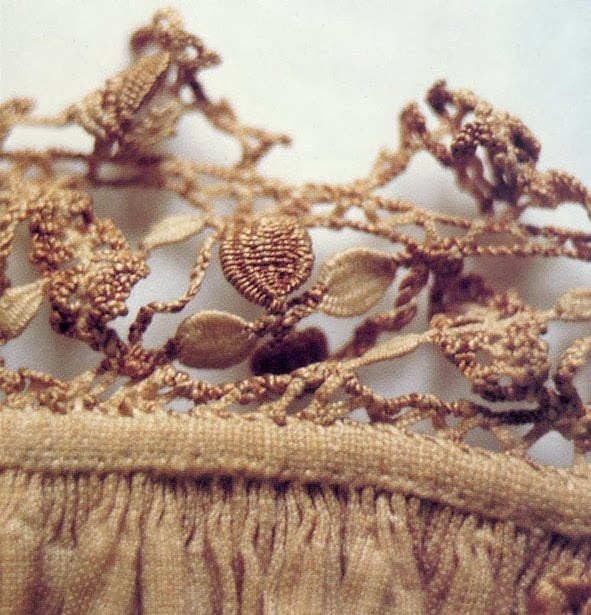
One of the main reasons for making this rather plain shift with a simple white smock was that I wanted to use the lovely antique golden lace I got from my mother in law, forming the edging of a lovely but really worn brocade table cloth. And there are some extant camicias with golden lace on the edge, excellent inspiration:

And this is how it turned out, with a side gore inserted and replacing the armpit square gore. The cuffs are plain and simple, since they will not be showing at all.
It took some effort to get the bias sewn to the smocking on the neckline and then attaching the lace, but I do think it was worth every minute and every pricked finger, this will for sure be a well used smock.
 First I pinned the bias strip over the smocking, trying not to stretch it too much.
 Then I sew the bias down over the edge, thus forming a firm edging for support of the rather heavy golden lace.
 The lace was pinned on and then sewn with a fine brown silk, that does not contrast too much to the rather old looking lace.

söndag 10 november 2013

Pretty protection

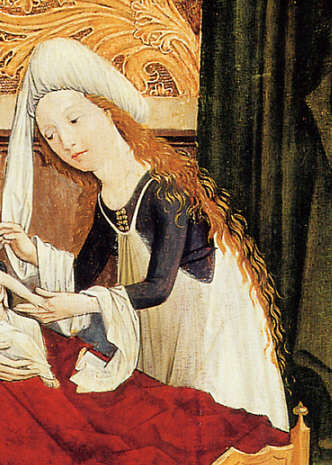
In striving for a full and complete late 15th century wardrobe I simply cannot be without a good apron. And browsing through period artwork the double apron, or Doppelshurz, sticks out as the most common. And it is so functional, protecting the skirts both front and back. Some call it a midwife´s apron, and it is definetly common in depictions of the birth of Christ on the female helpers, but it shows up in other situations as well.
Apron

For my apron I decided to gather pleats on top front and back, and the fabric I used is not pure white as in most depictions, but striped with thin black stripes. But I decided not to be to true to the originals but to make my own interpretation. It turned out to be a bigger project than I had imagined, mainly because my stubborn decision to pleat it so much. But the result was worth it and I will be proud to wear it at our next upcoming local event, where I will be head cook.
 The weather could have been better but here I am, standing in a rather cold November rain, in the Housebook dress, the new smock that is almost done and the apron. I was afraid that I would have to shorten the shoulder straps, but it worked just fine. I bought the fabric from my favourite Polish merchants at the Medieval market in August, it is a rather fine linen with black stripes and I just loved it at first sight. I sew it with flax thread and the smock is sewn with a rather heavy black silk, reinforced in the back with similar seams in flax.


The cut is really simple, I think it ought to be two rectangular pieces, just gathered at the top and sewn together in the sides, but I found it hard to get the smocked part as thin as I wanted it so I simply cut it into two trapezoid shapes. The top part I gathered with a smocking thread and then I sew right across the pleats with the black silk, reinforcing the back with similar seams, approximately two centimeters apart.

söndag 20 oktober 2013

Focus, focus, focus - Oh shiny!

It is hard getting anything done when I constantly get distracted. Distracted by new images, ideas, Oh-I-Must-Do-That-project ideas and other shiny stuff. Hence there is nothing much to show here, and it is not for lack of trying, I promise. But now I will make a huge cup of tea, put the computer down, hide the phone (whoever made Pinterest into an app must be an evil genius keeping everybody else occupied) and get going on my ongoing projects. This apron I have been working on for a couple of months could be finished in an afternoon, I´m sure of it.

måndag 12 augusti 2013

Nothing gets you going like a deadline

So, on Sunday morning, just before leaving for the Opening Parade of the 30th Medieval Week, I had it all done. And so this is the turnout of my teal blue Housebook dress, photo courtesy of Lia de Thornegge, just before court on Wednesday evening.
And yes, I need to make new smocks that fit this neckline better. It is on the to-do-list for the Autumn.

The week has, as always, been packed with friends, old and new, activities, parties and far too little sleep, as it should be. But me and the boys even made it to the beach for a short break just after the Principality Tourney. The youngest clearly thought more of the weather than us other two.